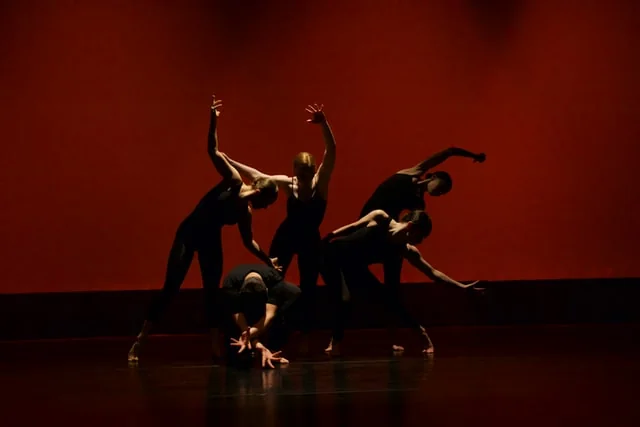
Contemporary Dance Classes in SouthamptonNo exams, no auditions, nobody marking you.
Contemporary in this city sits mostly behind syllabuses, gradings and children’s timetables, which leaves adults who simply want to move with nowhere obvious to go. This page is the queue for the alternative. Add your name; when the queue is long enough we take a room, bring in a teacher and email everyone the evening and the address. It runs at £10 a session or £32 for a block of four, and nobody in that room will ever be assessed, graded or asked to audition for anything.
A room only exists once people ask.
Five details, half a minute, and no obligation waiting on the other side. We ask for a postcode because the Bargate end of town and the Ocean Village end pull hired rooms in opposite directions. The start-date email lands with this list first, before any of it goes public.
Technique without the gatekeeping.
Contemporary is the least prescriptive family of dance there is: weight, breath, momentum and floor, borrowed loosely from ballet and then released into something far more forgiving. It rewards paying attention rather than being bendy, which makes it unusually kind to a body that has spent fifteen years at a desk. Nothing here builds toward a grade, an exam or a medal — there is nothing to pass and nobody keeping score.
Nothing to pass. No gradings, no medals, no end-of-year assessment. The class exists for the hour it occupies and then lets you go home.
Flexibility is a result, not a ticket. Nobody is asked to touch their toes at the door; range turns up slowly, on its own, as a side effect of showing up.
Floorwork stays optional. Getting up and down off a wooden floor is a genuine ask for some knees, and standing variations of everything exist.
What a contemporary evening tends to hold.
once the list fills — every teacher builds this differentlyBreath and weight
A long, unhurried warm-up that is mostly about noticing where your weight sits and getting the breathing involved. Least glamorous quarter of an hour, biggest change over a block.
Travelling and falling
Moving across the room — swings, spirals, controlled collapses, the business of giving in to gravity and catching yourself. How far this goes is a judgement made on the night.
A phrase to keep
The last stretch strings the material into one short sequence, run to music with the room fairly dim. Nobody watches from the side.
shaped by whoever is teaching — a flavour of the evening, not a running order we can promise
Turn up for the weeks that fit around everything else, and lose nothing at all by missing one.
Four weeks in a row is about when the warm-up stops feeling like homework and starts feeling like the reason you came.
Your name is a vote for the class happening and a place at the front of the queue when it does. It commits you to precisely nothing.
we publish rates rather than hide them behind an enquiry form and a follow-up conversation
The adults this city keeps forgetting.
Southampton is not short of contemporary dance — it is short of contemporary dance for people over twenty-five who never did any as a child. Almost everything on offer sits inside a school structure, an exam route or a company audition, and the waterfront arts crowd around Ocean Village has nowhere casual to send a curious beginner. A weekly, printed-price, no-assessment room near the Bargate is a small thing to want and a surprisingly hard thing to find.
Portswood and the universities supply plenty of people who danced until eighteen and then stopped dead. This is the class that lets them start again without competing.
The postcode box quietly decides the search radius when we go looking for a room with a floor worth dancing on.
Contemporary, plainly put.
the nine that come up before anyone signs anything ↓
Do I need any dance background at all?+
No, and roughly half the room won’t have one. Contemporary gets taught from weight, breath and walking rather than from positions you were supposed to learn at seven, so a genuine beginner is not at the disadvantage they might be in ballet.
Is there an exam or a grading later on?+
There is nothing to sit and nothing to pass. No gradings, no medals, no assessments, no annual show. It is a weekly hour that ends when it ends, which is what most adults are after and oddly hard to find locally.
How flexible do I have to be already?+
Not at all, and this is the single biggest myth attached to the style. Range of movement is something the class slowly gives you; it is not an entry requirement. Nobody will be asked to demonstrate a split at the door or anywhere else.
Will there be floorwork, and can I skip it?+
Most contemporary teachers use the floor for something, and you can absolutely opt out. Say so at the start and a standing version of the material comes back to you — knees, backs and hips being what they are past thirty.
What do people actually wear for this?+
Soft, stretchy layers, plus bare feet or socks, since grip is usually the enemy. Leggings and a t-shirt cover it. We do not stock, lend or sell kit of any sort, so please buy nothing on our account before a first evening.
When would the Southampton class begin?+
Not before the list can cover a hall and somebody to teach in it. Contemporary tends to fill more slowly than the party styles, so this one is worth a name early — the launch email carries the address, the evening and the first date.
Is this modern, lyrical or release-based work?+
Whichever the teacher we book leans toward, and honestly the first month looks similar across all of them. The launch email will say what the person leading it trained in; beginners rarely notice the difference until much later anyway.
Am I too old to start contemporary now?+
The list runs from 17 to 75 and the seventies end is real. Adult beginners are often better at this than teenagers, because contemporary rewards patience and paying attention, neither of which improves with youth.
Can I bring somebody along with me?+
Yes, though please put them on the list too — headcount is what decides whether the class runs, so an unlisted friend is invisible to us. Arriving with somebody you know makes a first evening far easier, and most people do.


